
Author: Faib Meier

  • Interview with our blogger Faib

    Interview with our blogger Faib

    Q: Faib has been with us from the very beginning. Or rather, he was one of the founders of worshiptrainingresources.com. Why did you start this non-profit organisation?

    A: “We’re still in our early stages, but the vision is to create resources for worship teams to strengthen their members in their faith, their skills and their teamwork. The aim is not only to produce and offer our own material, but also to point people towards others who already have brilliant resources (which we don’t need to reinvent). It is intended to be a platform that brings worshippers closer to the heart of God.”

    Q: How exactly do you go about bringing worshippers closer to God’s heart?

    A: “Our ‘flagship’ is probably our newly published book: ‘The Workbook for Worshippers’ (now available in German, but it is translated into english and waits to be correctet by a professional). This book is specifically designed for worship-team rehearsals. It contains 42 lessons, each lasting around 20–30 minutes, and is best read together with the whole worship-team. – Another resource is our worship blog, which will soon feature articles by other worshippers as well. We’re also planning Bible reading plans with a specific focus on worship in the Bible. And we’d like to support worship-teams in person through coaching, training days and so on.”

    Q: What qualifies you to write and teach about worship?

    A: “Certainly not my musical training.” (laughs) “Unfortunately, that’s limited to just two years of recorder lessons in primary school. – But I’ve been involved in worship for 20 years, studied theology for four years, and probably my most notable training is that I graduated from the Worship Academy in Switzerland. Apart from that, I can only draw on a wide range of experience that I’ve gathered over the years.”

    Q: What sort of experiences are you talking about? Where did it all start?

    A: “It all started when, as a twelve-year-old, I was appointed worship leader of our church’s teen band (ETG) on the grounds that I was the only one who could play four guitar chords. Luckily, we had a coach who had the full range of skills! A few years later, that church sadly had to close its doors and I joined ICF Zurich. At the new church, I was accepted into the band and given great support by Luca Aprile. Soon I was playing acoustic guitar, electric guitar and bass there. One of my best friends, Dominique Leppert, was involved in the sound engineering there, and so I learnt to view the band also from his perspective. And so we went through all the age groups together, until I then began studying theology at ISTL Zurich and got a job at FEG Wetzikon.”

    Q: How did your degree and the move to the FEG affect your worship?

    “On the one hand, I took over the teen band at the FEG and so got to know the role of a coach better. On the other hand, my degree challenged my faith and ultimately strengthened it. I suppose I have to generalise a bit here, as my degree programme focused on theology and leadership rather than worship. Nevertheless, I served also there at ISTL, first as an audio technician and later also as a worship leader, in the ‘Mini-Celebrations’ organised by them at the start of each day. My studies helped enormously in understanding the theology behind the songs, so that I can sing them even more from the heart. – I’d even like to make it a standard requirement that every worship LEADER should have studied theology for at least a year. Worship is sung theology, and this shapes our church. We should understand very clearly and precisely what we’re singing and what kind of words we’re using to influence our brothers and sisters in the faith!”

    Q: What was the largest and what was the smallest “audience” you’ve led in worship?

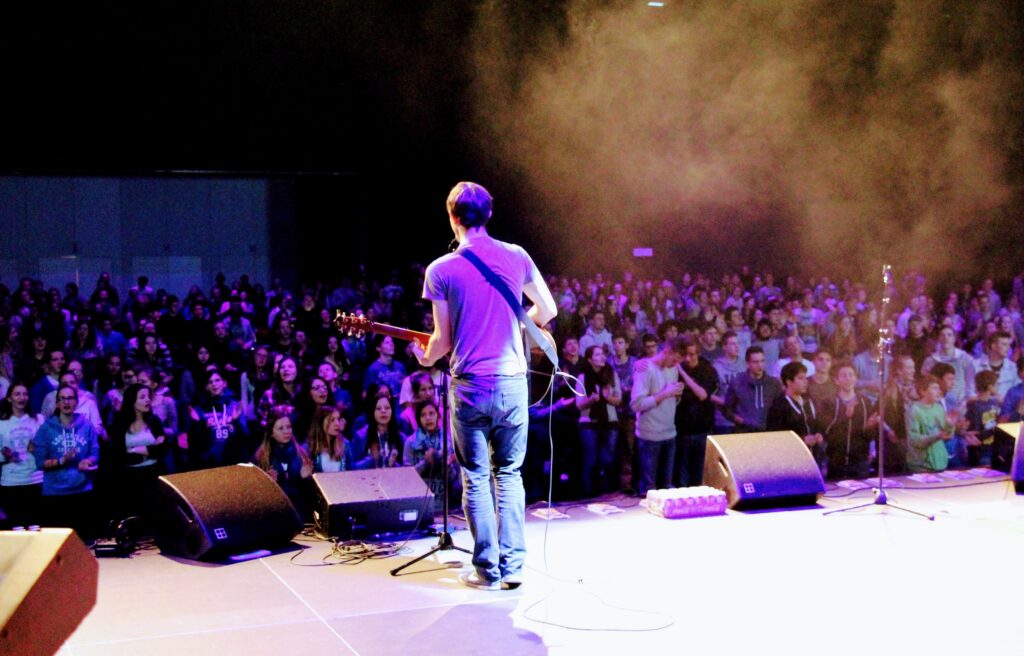
    A: “The largest was probably a National Day of Prayer in Switzerland, where I led a song… in French!” (laughs) “Unfortunately, my French isn’t really that good! Apologies to all French speakers here. But yes, there were about 3,000 people there. – The smallest was probably a few times in a small group that I was part of, where somethimes there was only one other person apart from me. So we worshipped together.”

    Q: Have you had an experience that has shaped you as a worship leader?

    A: “Specifically as a leader, I remember a 100PRO OpenAir event where I played a set with friends, featuring some of my own worship songs and others. We’d reached the most intimate moment and were about to build up the energy again, planning to finish with a few ‘upbeat songs’. And that’s when it happened: a cable on my pedalboard had a loose connection and my guitar cut out. I was so used to leading with my guitar, and that very guitar cut out. – It was almost as if God was saying to me, ‘You don’t need this to worship me.’ – And so I carried on worshipping without my guitar. That was a really good challenge!”

    Q: You said that you’ve written songs yourself. Do you still do that?

    A: “Yes. I’m actually working on a psalms album, for which I’ve translated the texts of entire psalms into Swiss German and then turned them into songs.”

    Q: But you live in Finland now – don’t you write in Finnish?

    A: “To be honest, I only tried it once, just a bit. But that was a few years ago. Maybe I should give it another go… I think the reason I’m currently writing songs in Swiss German is because I want to share my personal worship with my son.”

    Q: What advice would you give to people who want to start serving in worship?

    A: “If I could give just one piece of advice, it would probably be this: ‘Worship more at home than anywhere else.’ The reason is this: in this way, you strengthen your personal relationship with Jesus Christ. This then becomes evident when you worship together with others.”

  • Translated worship songs? Yes or no?

    Translated worship songs? Yes or no?

    At least in Switzerland, we still often sing songs that have been translated (usually from English). – So I found myself wondering: why do we actually do that? Don’t we have enough songs – or enough good ones – in our own language? What are we trying to achieve with these translations?

    I’ve been thinking about this question for quite some time now. But before we can really weigh up the pros and cons, let’s take a look at the reasons why songs are translated in the first place:

    Reasons why we translate songs

    One good reason why we translate worship songs into other languages, I learnt at Hillsong Konstanz, where I was also part of the song translation team for a short time. They have the vision that Hillsong is one house with many rooms (locations). Some of these rooms are not based in Australia, but in other countries with different languages. Because all Hillsong locations sing exclusively Hillsong songs, but not all locations conduct their activities in English (nor do they write their own songs in their own language), translations of their English songs are needed. The same probably applies to other Christian denominations as well.

    Another reason is probably that we are fascinated by certain songs (and their message) and want to sing them in our mother tongue (because that way we can understand them better).

    PS: Translating songs is a fine art!

    Pro-arguments

    • We understand the lyrics best in our mother tongue. Not everyone in German-speaking countries, for example, understands English worship songs that well.
    • We are not so limited to songs that were originally written in our own mother tongue.
    • On mission trips, many Christians around the globe often know songs such as “How Great Is Our God” in their own native language. This makes it possible to worship together. (Experienced first-hand in Switzerland, Austria, Hungary, Moldova and Finland.)

    Contra-arguments

    • The vision – and often the theology – of the church that sings translations from other church organisations is stretched, and sometimes even pushed to its limits.
    • Most languages already have plenty of their own worship songs.
    • Songs are often tied to a specific cultural context. It might therefore be better to use songs from one’s own country, with their own rhythms (and dances), etc.

    Action step: I’d like to encourage you to write your own songs in your own language for your own country, church association and perhaps even specifically for your own congregation. Songs that reflect the heart and vision of your church.

    Can you think of any other reasons for or against translating worship songs? Please share them in the comments below:

  • Loud worship and praise

    Loud worship and praise

    Really! Why does worship always have to be so loud? Can’t it just be done quietly!?

    From a purely physical point of view, instruments and voices automatically produce a certain level of volume when they make music together. From this perspective, worship (when accompanied by music) can be neither exceptionally quiet nor completely silent. Otherwise, we would simply hear the speakers humming. And that really is not the best worship sound.

    However, I wanted to find out what the Bible says about the volume of worship music. I therefore did not examine how Jesus went into silence to pray. That is also a form of worship, although without music. Apart from that, there are only a few verses in the Bible on the subject of “being still”. Most of them are in the context of: “The Lord will fight for you; you need only to be still.” (Exodus 14:14 – NIV).

    In the Psalms (the book of songs in the Bible) there are not really any passages that suggest we should worship in a quiet way. The most “quiet” psalm is probably Psalm 131.

    What I do find over 20 times in the Psalms, though, is that we are to worship and praise God LOUDLY in every emotional state (from despair to joy) (Psalm 3:4; 18:6; 20:5; 26:7; 27:6–7; 28:2; 32:11; 33:3; 47:1; 48:11; 61:1; 66:8+17; 68:3; 77:1; 86:6; 95:1; 97:8; 102:1; 105:1; and so on…)! Here is an example:

    “Be glad in the LORD, and rejoice, ye righteous: and shout for joy, all ye that are upright in heart.” (Psalm 32,11 – KJV)

    There’s something about this loud worship music. It does not necessarily have to be deafeningly loud. But it can sometimes reach around 92–95 dB(A). – The thing is this: if music is poorly mixed, it sounds like it’s deafening even at a low volume. Often because certain frequencies have got out of hand. But if music is mixed really well, it sounds fine even when it reaches 95 dB(A).

    Action step: How can you, as a worship team, support your audio engineers, or even help them improve, so that your worship sounds better?

  • Selah

    Selah

    Have you ever wondered what that stand-alone word “Selah” means, which we find in some Bible translations? (In some translations, it simply appears as: // )

    This word appears a total of 71 times in the Psalms (for example in Psalm 3:2). We could even say that it is an essential part of the Bible’s book of hymns. But “Selah” is not only found in the Psalms; it also appears three times in a prayer by Habakkuk (Habakkuk 3:3, 9, 13).

    Theologians do not entirely agree on the exact meaning of “Selah”. The most widely held view is that this word indicates a kind of pause. – (Selah. – Pause.)

    But… “Selah” means much more than just a pause or an interruption. It could also refer to a repetition, an interlude, a rise in pitch, or something similar. In other words, it’s a kind of musical instruction on how we should play or sing something.

    “Selah” invites us to reflect on the preceding text (through a pause or an instrumental interlude) or to emphasise it (through repetition or by raising our voices). – It is not known how long or how intense these “Selah” sections are. However, it is highly likely that they vary in length. Or that they last until we have had a revelation about what this psalm (or section of it) is really about.

    Fun fact: “Sela” (without “h”)is the name of two different places mentioned in the Bible (one of which is found in Isaiah 16:1).

    Action step: How might this “Selah” be put into practice in your worship-taeam andcongregation?

  • Holy silence?

    Holy silence?

    In an world where we look at our smartphones an average of 88 times a day. In an world where our calendars rule our lives and we can hardly find a moment of peace (and when we do relax, we naturally have to post about it on all platforms with the appropriate hashtags), we find ourselves, usually on Sunday mornings, in a time of worship.

    Usually we only have about 20-25 minutes for praise and worship in our churches. So naturally we want to reach as many people as possible in that time. Therefore it’s best to start with a really energetic praise song and then move on to the more reflective songs. Towards the end, always be flexible about which song would best round off the sermon. We could finish with another upbeat song. After that…

    STOP

    I have nothing against these activities, and yes, people’s time is precious, and we want to honour that by creating a space where they can encounter God as deeply as possible and also recharge their batteries. But sometimes (not always!) the best way to worship God is simply to be still. Yes, exactly. Silent. Sooo quiet. Not the whole time, but just a few minutes of total silence. No piano, no electric guitar, just you and God.

    “The Lord is in his holy temple; let all the earth be silent before him.” (Habakkuk 2:20 – NIV)

    But this few minutes feels like it goes on forever! And of course, it’s a real challenge for the band leader to know when the best moment is to start up again. But don’t panic. In heaven, there was – or will be – a full half-hour of silence! (Revelation 8:1).

    If silence is introduced effectively, it could be the best thing that has happened to our congregation this week! Silence in worship contains elements of revelation (of who God is) AND of response, explanis Matt Redman in his book “Facedown”. Sometimes we experience God in loud worship, and that’s brilliant. But we shouldn’t miss the opportunity to experience God in the stillness during a time of worship. In His presence, we quiet our hearts and automatically begin to marvel at God’s greatness and holiness (Psalm 131).

    The silence between songs can be rather awkward and make it difficult to really immerse yourself in worship. But intentional silence can lead you into a deeper level of worship.

    Action step: Here’s a question I like to ask myself from time to time, which fits in with this: “Is the noise around you quiet enough for you to hear God’s whisper?” For example: sometimes God is found in a gentle whisper, just as in 1 Kings 19:12–13, when God appeared to Elijah.

    To sum it up: I’m still against unnecessary interruptions, or awkward silence during worship times, but I’m definitely in favour of deliberately planned and well introduced times of silence during worship sessions.

  • True creativity

    True creativity

    In today’s society, it’s almost impossible not to come across a professional who excels at something and whose skill inspires us in some way. However, as long as we’re fascinated by this person and our inner voice tells us, “I want to be able to do that too”, we simply become imitators. After all, it might just be the case that we don’t have exactly the same talent as that person? I’d like to challenge you to do things in a different, creative way. You’re an original, not a copy of someone else. If you want to take it a step further and prove your discipline, why not set a Guinness World Record? 😉

    When it comes to worship, setting a world record is probably a bit more difficult… but even there you can be incredibly creative and develop your own style. Especially when you’re writing songs. Other people can be a great source of inspiration, but true creativity comes from God himself. Just how creative must God have been to create this world and us (sometimes very complicated) humans, let alone the entire universe (Genesis 1)!? When we are connected to God and He lives within us (we have a relationship with Him), then we have access to true creativity and can stop copying others. However, to have more creativity in songwriting, it takes not only a living relationship with the source of creativity, but also practice.

    True, fresh creativity comes from the source of all creativity.

    Action step: How and/or where does God inspire you? Go to that place and let God inspire you.

  • Wherever you look…

    Wherever you look…

    … that’s where you’ll end up too. You may be familiar with this saying. It’s used mainly when driving, to ensure you don’t crash into oncoming traffic at night. We find this principle in the Bible too: when Moses spent 40 days on the mountain with God, the glory of God shone on his face afterwards (Exodus 34:29). When we, as followers of Christ, follow him, we too become more and more like little Christs (as Christians were called 2000 years ago). If we want to have Spirit-filled worship, then I recommend spending more time with the Holy Spirit. Wherever you look, that is where you end up.

    Action step: I’d like to encourage you to spend more time with God, so that you can build an ever-stronger relationship with Him, and so that this is reflected in every aspect of your life.